
All media queries to babylab@bbk.ac.uk
- Bloomsbury Festival October 29th & 30th 2026
 The Birkbeck BabyLab & ToddlerLab are part of this year’s Bloomsbury Festival! We’re hosting an interactive mini science expo in the Conservatory at Birkbeck Central on Malet Street. The free event takes place over October half term, on Thursday 29/10 10am-4pm and Friday 30/10 10am-3pm. This is aimed at families
 - Professor Denis Mareschal gave evidence at Houses of Parliament on Neuroscience and Digital Childhoods
 On 10th June 2026, Birkbeck Professor Denis Mareschal was invited to the Houses of Parliament as a witness to the Science, Innovation and Technology Committee‘s inquiry into Neuroscience and digital childhoods. He gave evidence on the impact of digital technology use on the developing brain.
 - Birkbeck & UCL awarded £3 million by DfE
 Birkbeck and UCL were awarded £3 million by the Department for Education to establish a new policy research centre focused on educational neuroscience. CBCD’s Prof Denis Mareschal will be Co-Director, leading investigations of topical questions facing education today, including how cognitive and biological factors could support earlier identification of children with special educational
 - STAARS research featured in Channel 5 documentary “Does your child have ADHD?”
 Professor Emily Jones and the STAARS research are featured in Channel 5’s documentary “Does your child have ADHD?”. Watch for a fascinating insight into parents navigating ADHD diagnoses in their children, the help they find and the impact on their lives. Learn more here https://www.channel5.com/show/does-your-child-have-adhd
 - Does neurodiversity affect eating behaviours in teenagers?
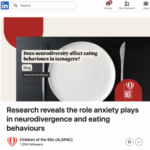 Dr Virginia Carter Leno is quoted in ‘Children of the 90s’ research blog (based on data from the Avon Longitudinal Study of Parents and Children) on the role of anxiety in eating behaviours of children with high ADHD/ASD traits. Read the full article here: https://www.linkedin.com/pulse/research-reveals-role-anxiety-plays-neurodivergence-uhive/
 - Prof Denis Mareschal interviewed for evening news impact of screen time on child development
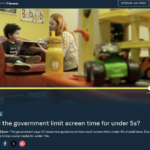 CBCD Director, Professor Denis Mareschal, was interviewed for both ITV news and Channel5 news for their evening news features about upcoming government guidance for parents on screen time in under 5s. Huge thank you to one of our superstar young scientists and his family for carrying on with our research
 - How the ‘postcode lottery’ of parenting really impacts young children
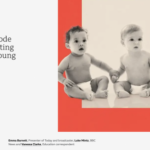 Professor Emily Jones is quoted in the BBC News indepth article on the “postcode lottery” of parenting. Read full story here: https://www.bbc.co.uk/news/articles/cjdr42ez3d2o
 - Babylab & Toddlerlab researchers feature on BBC Radio 4’s ‘Child’ podcast
 Three of our CBCD staff were interviewed for BBC Radio 4’s ‘Child’ podcast with India Rakusen (https://www.bbc.co.uk/sounds/brand/m001v4dd). The new series features Denis Mareschal (episode 1 ‘Happiness’ & 4 ‘Anger’), Chiara Bulgarelli (episode 5 ‘Sadness’) and Virginia Carter Leno (episode 7 ‘Anxiexty).
 - Unleashing the Toddlers: Lessons from the new Birkbeck ToddlerLab
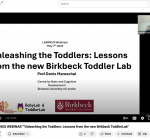 Professor Denis Mareschal recently gave a webinar for Learnus, a charity specialising in bringing research innovations in neuroscience to educators. He discusses lessons learned from 4+ years of studying young participants in our incredible ToddlerLab. Watch here: https://www.youtube.com/watch?v=wHQhgFSLHAo
 - The Babylab features in Channel 5’s “Are you Autistic” documentary!
 Watch Channel 5 to see a family visiting the Babylab and findings from the STAARS study! Professor Emily Jones discusses studying autism and what it means with presenter Dr Claire Taylor. https://www.channel5.com/show/are-you-autistic
 - ToddlerLab research published!
 Our first paper on brain activity in mothers and their children in the Toddlerlab has just been published! We found when mums and kids solve puzzles together, their brains synchronise. Read more here: https://direct.mit.edu/imag/article/doi/10.1162/imag_a_00509/128247/Analytical-pipeline-optimisation-in-developmental
 - “5-Minute” interview about virtual reality research with young children
 Check out Dr Chiara Bulgarelli’s “5-Minute” podcast interview, where she explains how and why we use virtual reality to study the development of socialisation and social preferences in young children. https://www.youtube.com/watch?v=fJzGcs-MgA0
 - Royal Foundation launches “Shaping Us Framework” with forward by Prof Emily Jones!
 We are delighted to see the publication the Royal Foundation Centre for Early Childhood’s Shaping Us Framework. The Framework describes core social and emotional skills in an accessible way, which everyone in society can use and understand – as the basis for action. Social and emotional development begins in early
 - Babylab featured on BBC Persia!
 Calling all Persian speakers! The Babylab & Toddlerlab, Prof Emily Jones and Dr Jannath Begum Ali were featured on BBC Persia about their work studying ASD in babies and children. From 17:20 in, https://www.youtube.com/watch?v=C-elcd1Nv9M
 - Brain Imaging feature on ITV news!
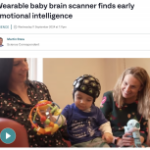 The Babylab & Toddlerlab DOT study and Lumo brain imaging device were featured on ITV news with Martin Stew! We had the pleasure of hosting ITV news while they filmed our collaborator Liam Collins-Jones and Prof Emily Jones, not to mention our top infant scientist and very supportive mum! Read the
 - CBCD’s Ori Ossmy featured on BBC Brain Hacks!
 CBCD Lecturer Ori Ossmy was filmed in the ToddlerLab for BBC’s ‘Brain Hacks’ documentary series. Check out his insight on why babies are the best learners, even compared to Chat GPT! https://www.bbc.com/reel/video/p0fc9tlx/chatgpt-why-we-re-still-smarter-than-machines
 - Fine motor skills in young children linked to later GCSE scores and behaviour
 Published research from CBCD PhD student Aislinn Bowler involving assessments of over 9500 children identifies link between fine motor skills in toddlers and later GCSE scores and behaviour. Fine motor skills in young children, for example drawing, folding paper and block building, may play an important role in the pathway between infancy and later educational and behavioural outcomes
 - Behind the scenes in our ToddlerLab!
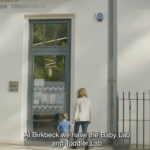 Birkbeck filmed behind the scenes in our ToddlerLab to celebrate the University’s 200th birthday! Listen to our professor Emily Jones discuss the aims of the ToddlerLab, and see a sneak peek of one of research fellow Chiara Bulgarelli’s studies in our virtual reality lab, the CAVE! https://www.youtube.com/watch?v=PHr3rva-_Ps
 - Professor Denis Mareschal offers expert comment on infants artwork preferences
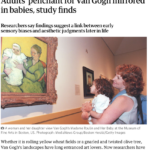 The Guardian article “Adults’ penchant for Van Gogh mirrored in babies” covered research from the University of Sussex which our centre director, Professor Denis Mareschal gave expert comment on. “In a nice nod to Goldilocks, infants prefer to explore stimuli that are neither too simple nor too complex to decipher,
 - Listen to our wonderful Chiara Bulgarelli describe her research into empathy with toddlers
 CBCD research fellow Chiara Bulgarelli is interviewed by BabyBrains for their WoW podcast. Click the link to learn more about Chiara’s research with toddlers and the development of empathy. https://www.youtube.com/watch?v=7rHjgkomy_o